Find a Showroom

How to Measure for Curtains in 5 Steps
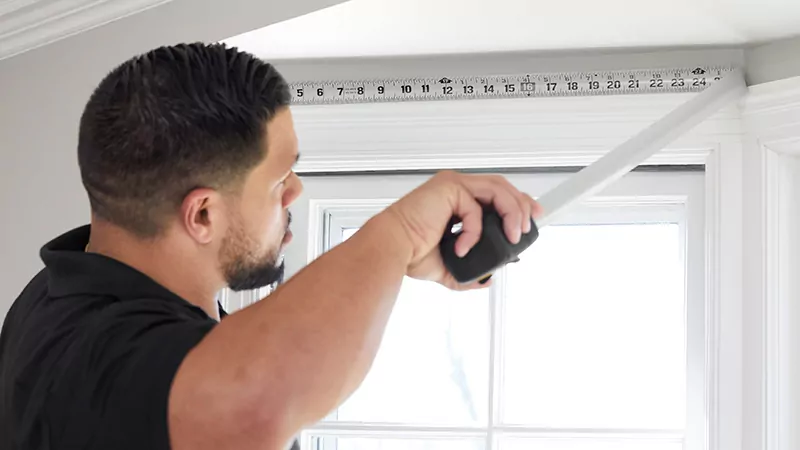
Measuring curtains is a simple five-step process that includes gathering your tools, choosing your mount type, measuring your window, calculating curtain width, and determining curtain length.
However, several factors can affect your final curtain measurements, including your preferred curtain length, how high above the window you plan to mount your rod, and how far beyond the window you want your curtains to extend.
Drapery is an impactful window treatment option that adds visual texture and dimension to any room. Learning how to measure for curtains ensures you order the correct curtain panel length and width. Follow the steps below to learn how to measure for drapes, plus get best practices for height, width and length to ensure your curtains look their best when hung.
The General Rule for Choosing Curtain Sizes
As a general guide, curtain panels should be 1.5 to 2 times the width of your window for a full, tailored look. For length, the most common options are sill length (to the windowsill), floor length (just clearing the floor), and puddle length (3 to 6 inches of extra fabric on the floor).
Steps to Measuring Curtains and Drapery
The five steps below walk you through each measurement in detail so you can order with confidence and understand which curtain size works for you.
Step 1: Gather Your Tools
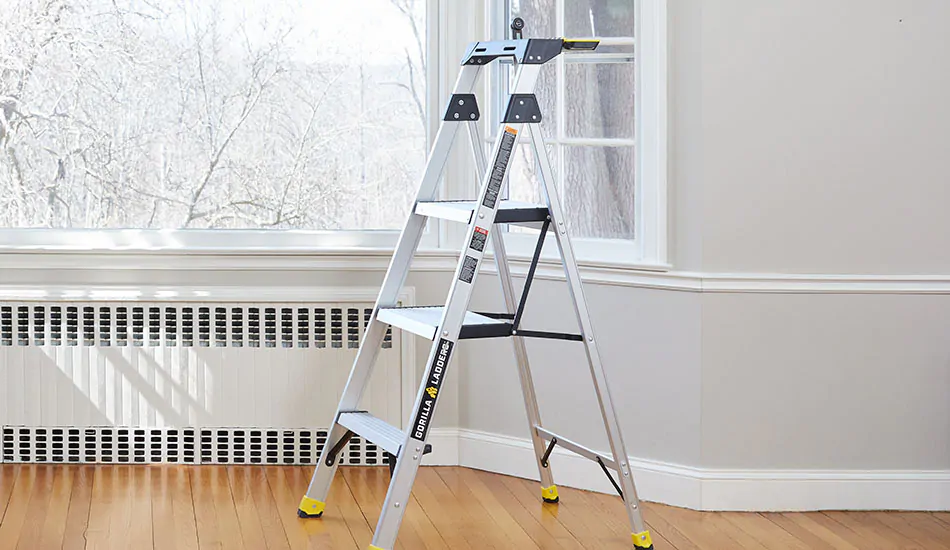
The first step in learning how to measure curtains is gathering the tools you’ll need for the job. These are very common, and you likely have many, if not all, already at home:
- Metal measuring tape – Metal gives you the most accurate measurement as metal isn’t vulnerable to stretching over time like plastic.
- Stepladder – Be sure your ladder is tall enough for you to easily reach where you’ll be hanging your curtain rod.
- Pencil – A pencil is safe to use on your wall to mark where your curtain height and width will be as well as where curtain rod brackets will need to be placed.
- Level – A level is essential for ensuring your pencil markings for your curtain rod’s placement are all in-plane and even — and you’ll also use it again to make sure you install your curtain rod evenly.
Step 2: Decide How You Will Mount Your Curtain Rod
The next step for how to measure for curtains correctly is to decide how and where you’ll mount your curtain rod or track system. How to measure for curtain rods or a track will vary depending on whether you mount your curtains inside the window frame (called an inside-mount) or outside the window frame (called an outside mount). To learn more about inside mount vs outside mount blinds, check out our blog for more guidelines. Additionally, for an outside-mount application, which is the more common choice for hanging drapery, your drapery hardware can either be mounted on the wall or on the ceiling.
Learn more about each application to help you further decide.
Inside Mount
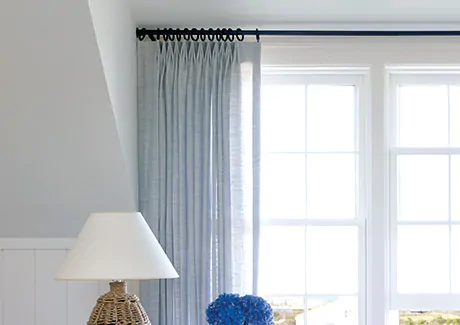
Inside-mounted curtain rods are those that sit inside the window frame. Inside-mounted drapery can be held by a tension rod (not sold by The Shade Store) or a curtain rod with brackets. Using a curtain rod means the brackets will likely need to be mounted into the sides of the window frame, or in the top or “ceiling” of the window frame.
Outside Mount
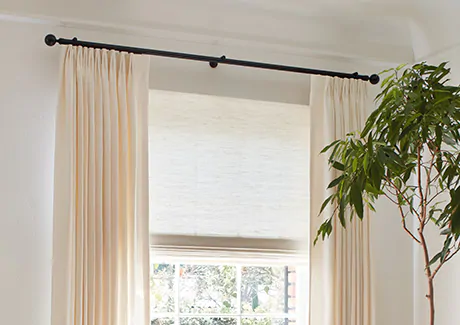
Outside-mount curtain rods are those that are installed outside of the window frame. These can either be installed into the wall above your window (pictured) or into the ceiling. The choice is mostly a matter of preference, but in the case of crown molding at your ceiling, it’s typically best to install into the wall rather than the ceiling.
If you choose an outside mount application, you have two more drapery hardware choices to make before learning how to measure for curtains: Whether to mount your curtain rod or track system on the wall or ceiling. This choice is mostly founded on preference, but there are a couple factors that may influence your decision.
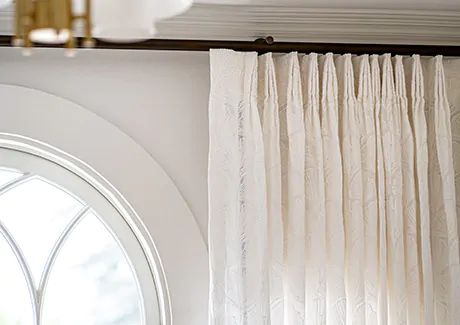
Wall Mount
A wall mount is a good choice if you have crown molding at your ceiling, or you have cathedral ceilings.
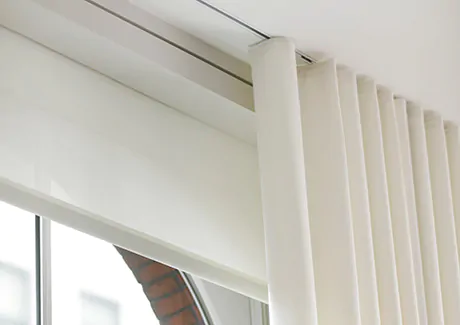
Ceiling Mount
A ceiling mount is best for shorter ceilings, as it creates the illusion of greater height for your wall and window.
Step 3: Measure Your Window’s Height AND Width
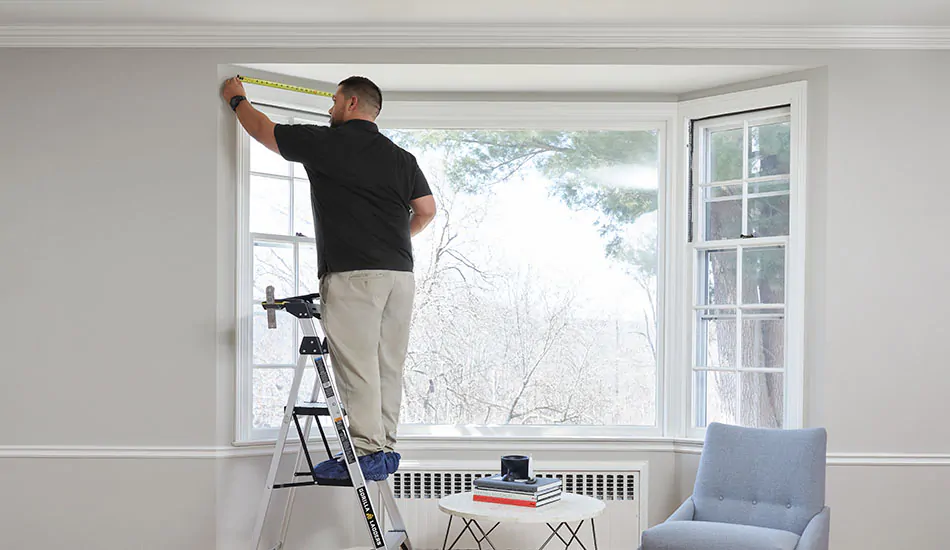
Once you decide on your mounting choices, the next step in how to measure for curtains is to measure your window’s dimensions.
How to measure your window will vary depending on whether you plan for an inside- or outside-mount application.
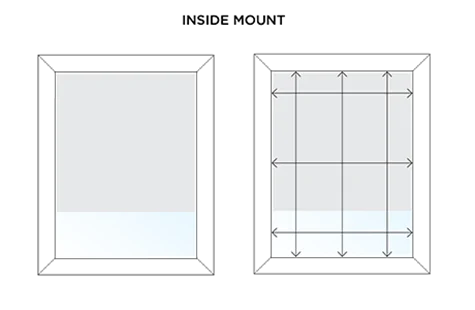
Inside Mount Applications
Measure the height and width of the window from the inside of the trim pieces from left to right and top to bottom.
Outside Mount Applications
Measure the height and width of the window from the outside of the trim pieces from left to right and top to bottom.
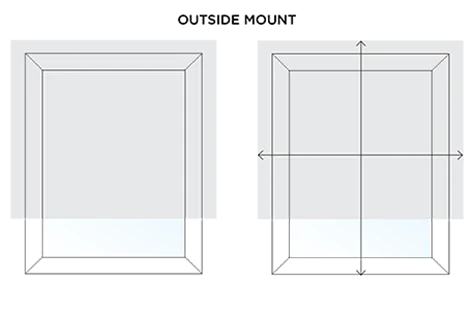
Once you have the dimensions of your window, you’re ready to learn how to measure for drapes in terms of width and length.
Step 4: How to Measure for Curtain Width
Learning how to measure curtain width requires two calculations:
- The width of your curtain rod
- The total width of your curtain panels
While the rod will be a straightforward, clear measurement of the area you want your curtains to cover, curtain panel length will require some math to ensure the curtains look lush and full whether drawn open or closed.
To learn how to measure curtains in terms of width, first start with your curtain rod:
How To Measure Curtain Rod Width
The measurement for curtain rod width will depend on your mount choice.
For inside mount applications, measure the width of the window from the inside edges of the trim. This curtain rod measurement will be equal to the width of your window calculated in Step 3.
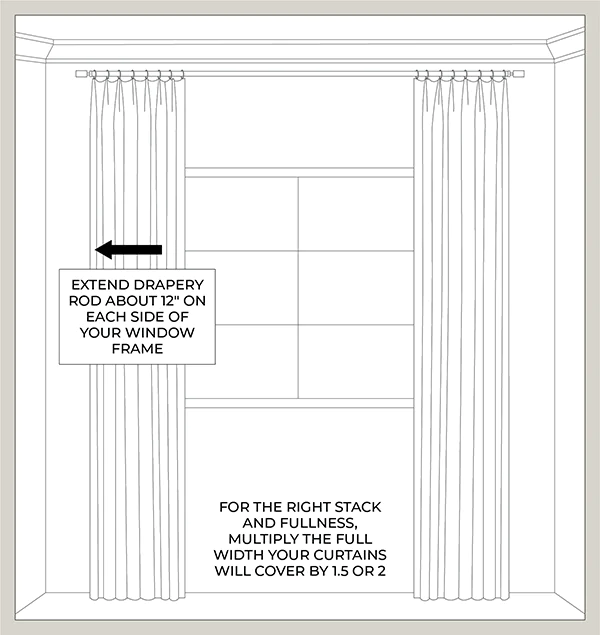
For outside mount applications, the curtain rod width will be the width you want to cover with your curtains, which will typically expand past the window frame by about 6 to 12 inches. Going beyond the window frame helps ensure you’ll be able pull your curtains fully off the window to let in the most natural light. Additionally, bringing your curtains out wider creates the illusions of a larger, more expansive window.
How To Measure Curtain Panel Width
To correctly measure curtain panel width, you need to first understand curtain stack and fullness, both of which play a role in learning how to measure for drapes in terms of width.
- Stack refers to the amount space the drapery takes up when fully drawn open to expose the window.
- Fullness of your curtains refers to how lush and full they look when drawn closed to cover the window.
For both inside and outside-mount applications, you want to account for a nice sense of fullness without creating too big of a stack. To do this, multiply the width your drapery will cover (or the width your hardware will span) by 1.5 or 2. This will give you a full look for most drapery materials, but some thinner materials like sheers may need about 2.5x or 3x the width.
How wide should curtains be for the best look?
Curtains should be 1.5 to 2 times the width of the area they cover for a full, well-proportioned look. For example, if your window or curtain rod spans 60 inches, your total curtain panel width should be between 90 and 120 inches. Sheer or lightweight fabrics may benefit from 2.5 to 3 times the width to achieve the same sense of fullness as heavier materials.
Important
If you’re measuring for decorative stationary drapery panels that don’t need to close over the window, you can likely opt for a smaller width.
READ THE GUIDE
Skip the Math: Order from The Shade Store
When you order custom drapery from The Shade Store, you only need to provide the width of the area you would like to cover, or the width of your drapery rod. We account for the fullness and stack in our handcrafted process based on the material you’ve chosen.

Step 5: Measure for Curtain Length
After you figure out the width measurements, you’re ready to learn how to measure for drapes in terms of length. The length of your curtains is the distance they span from the rod to your floor. How to measure for curtains in terms of length will depend on how high you’re installing the rod and how far you want your curtains to extend toward the floor.
To learn how to measure curtains in terms of length, first learn what the best practices are for how high to mount your curtain rod.
How High Should You Hang Your Curtain Rod?
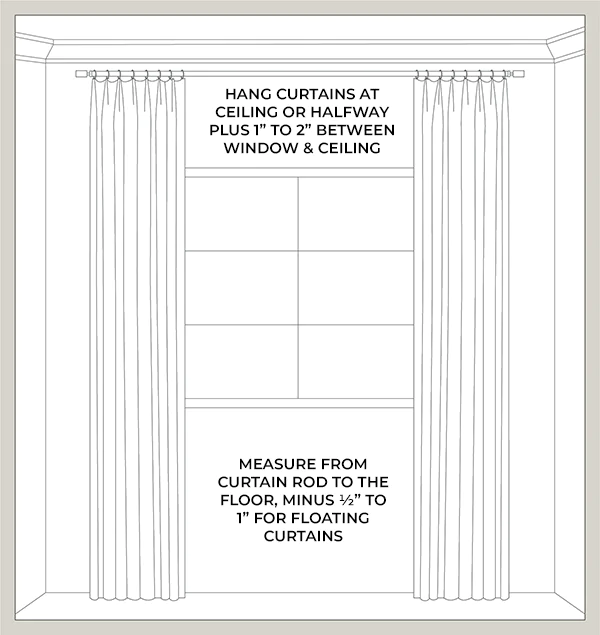
Typically, a good rule of thumb is to hang your curtains a little more than halfway or about two-thirds of the way up between the top of your window and the ceiling.
Hanging your curtains higher than the window frame gives the illusion of a taller window and can help make your overall room feel taller and larger.
While hanging your rod a little more than halfway up is an ideal best practice for most standard windows with 8- or 10-foot ceilings, there are some exceptions that require adjustments:
- Cathedral ceilings: Hang your curtains about 8 to 10 inches above the window frame to help the windows feel taller, without going excessively high.
- Shorter ceilings: Hang your curtains right at the ceiling or, better yet, ceiling-mount them.
- Crown molding at the ceiling: Hang the curtains right below the crown molding.
Once you decide how high to hang your curtain rod, you can decide how far you want your curtains to extend to the floor.
Standard Curtain Lengths: Where Will Your Curtains Fall?
There are several options for curtain length, and the choice is mostly dependent on your preference.
Sill Length Curtains
These curtains hang just above or at the windowsill. Ideal for more casual settings like kitchens, bathrooms or basements, this length delivers a simple charming aesthetic. However, due to the shorter curtain length, this style can make short windows and short ceilings look even shorter.
Measuring: Measure from the top of your curtain rod to the windowsill or an inch below depending on preference.

If you choose to have your curtains come all the way to the floor, you have a few more options to choose from. Floor-length curtains help to accentuate the height of your ceilings and will also create the illusion that shorter ceilings and windows are taller.
Float
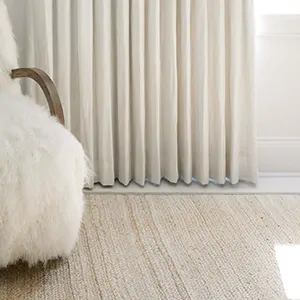
Float-length curtains hover just above the floor a crisp, tailored look.
Measuring: Measure from rod to floor and subtract ½ or ¼ of an inch
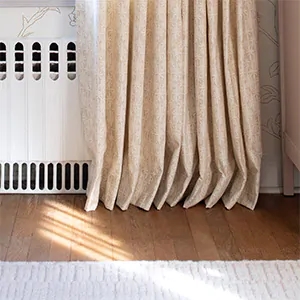
break
Curtains with a break kiss the floor, which is ideal for hiding uneven floors.
Measuring: Add 1 to 2 inches to your curtain’s float length
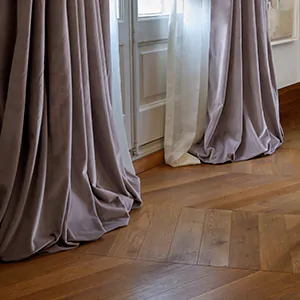
Puddle
Puddled curtains create lush piles of fabric for a luxurious look.
Measuring: Add 3 to 6 inches to your curtain’s float length
Now that you’ve decided on the height of your curtain rod and how far you want your curtains to extend toward the floor, you’re ready to learn how to measure for curtains in terms of length.
The Bottom Line: How to Measure Drapes and Curtains Length
The last measurement is also the most satisfying as it’s a culmination of all your decisions and finalizes how your curtains will look and feel in the room.
To measure for curtain length, start at the top of your curtain rod and measure down to where you want the end of your curtains to hang. For break and puddle-length curtains, be sure to add the right number of extra inches needed to get the desired effect.
Don’t Have Time to Measure? Leave it to Professionals
While learning how to measure for curtains is doable on your own, it does take patience, time and effort. If you’d rather save the effort while ensuring your curtains will fit perfectly, we offer free measurement services for Drapery, as well as shades and blinds, from The Shade Store. Schedule a home visit or a virtual consultation where our experts will lead you through the process step-by-step.
SCHEDULE A FREE PROFESSIONAL MEASUREMENT
Ensure your window treatments fit perfectly when you schedule a free measurement with our expert professionals.